 Day One Fixes
SolvedHow-toUpdated
How to Change Spells
Short answer
Now, the thing about combat is you have all your skills here on the left-hand side. But if you go right here to this tab that has this red, green, and blue bar, these are all your attack skills.
Overview of Combat Skills in Melvor Idle
Now, the thing about combat is you have all your skills here on the left-hand side. But if you go right here to this tab that has this red, green, and blue bar, these are all your attack skills. These are independent from all these skills.
How to Change Combat Stances for Optimal Damage
The only reason I am using block is because it trains my hit points as well as my defense skill in combat. Be sure you're using the right stance based off of the enemy that you're fighting so you're dishing out the most damage. And if you want to level these up, you're going to have to use the associated stance in order to gain XP for that combat skill.
And again, like I said, keep in mind based off of these levels determine what kind of gear you can use.
Melvor Idle 2: Beginner's Guide — Everything You Need to Know
Melvor Idle 2 takes a lot of what makes RuneScape and Dragon Wilds enjoyable and turns it into an idle RPG where you're constantly progressing whether you're actively playing or away from the game. You have plenty of skills to train, resources to gather, equipment to craft, plenty of different combat scenarios, and a whole progression system that connects everything together. Can seem complicated at first because there's a ton of menus and especially if you've never played the original Melvor Idle or an idle game, you have all these different skills available.
I'm going to talk about how progression works, which skills are worth focusing on very early on, how to manage your resources, and some important things to understand before you start getting into combat. The goal here is to give you a good foundation so you can get started and understand what you're actually working towards. The first thing you need to understand is how Melvor Idle actually works.
You select an activity such as cutting trees, mining or catching fish, and your character continues performing that activity over time. You'll gain experience, collect resources, and eventually unlock new things as your level increases. Now the really useful part is that Melvor Idle 2 also supports offline progression.
You don't need to leave the game running constantly. You can set up an activity, close the game, and return later to see what you've collected. You can also leave it on on your second monitor, which is what I normally do when I'm editing videos, and the game will continue to progress.
Now what I mean by this is if you're crafting something that requires materials and you run out, your character isn't going to be able to keep producing that item. One of the best habits you can build up early is checking what your chosen actually requires before leaving it running for an extended period. Fishing is a very useful place to begin in Melvor because it helps build up one of the main resources that you're eventually going to need for combat, this being food.
You can catch fish, prepare them through cooking, and start building a supply for when you're ready to start fighting enemies and take on quests. Not only are you leveling fishing, but then you can cook that fish to then level cooking. And if you want, you can sell some of that make easy early game gold.
And if you want to be a ranged or a magic build, you're going to focus on other skills, this being rune crafting as well as just crafting overall so you can make leather gear for ranged. A lot of what you're going to do, and if you've played RuneScape, you've played Dragon Wilds, or you've played a game similar to this, is you're going to look at something that you want to craft, and you're going to realize that you're going to have to work on one or multiple skills before you can even craft that item. Now, recommendation is to pick a simple goal and work backwards from it.
Like I said, if you want better equipment, figure out which materials you need, what ore type you want to mine, mine that ore in mining, process it into bars in smithing, then turn it into the gear set that you want. So whether you want to do melee, ranged, or magic, you don't need to master every skill immediately. Understanding how they work together is more useful than trying to level everything at once.
If you look over here on the right, it'll let you know how much XP you're going to get when you craft that, how much resources it's going to cost to make the item, as well as how much gold you're going to get when you sell it. Now one of the biggest additions in Melvor Idle 2 is the quest system. And this is one of the things that you're going to want to pay attention to right from the beginning is unlike the original game, Melvor Idle 2 has an actual storyline with quests that take you through different activities, introduce mechanics, and eventually lead you into more challenging content with better rewards.
This is particularly useful as well for new players because it gives you a sense of direction. Instead of starting at a long collection of skills, trying to work out what you should do, you can use the available quests to help establish your next goal. You can still spend time leveling different skills that aren't associated with the current quests you're doing.
You can gather different resources and explore different parts of the game. But when you're unsure what to do, one of the easiest things you could do is check your next available quest. If a quest requires a particular resource or skill level, you can start preparing for it while you work on other activities.
The first game didn't really have a fleshed out questing system, but in Melvor Idle 2, the quests are a natural way to introduce you to every skill because they're going to require you to do specific things throughout all skills to produce specific resources as well as pieces of gear and special items that you will eventually use to complete the quest. If you're kind of lost, you don't know what to do, check your quest tab and it'll kind of give you a little bit of direction on what you should do next and it also assists you in introducing something that you might not have done yet. It's worth checking your bank regularly, particularly before starting a long gathering session and before you make the game go idle because you don't want to leave an activity running for hours only to find that your inventory restrictions prevented you from collecting everything you expected.
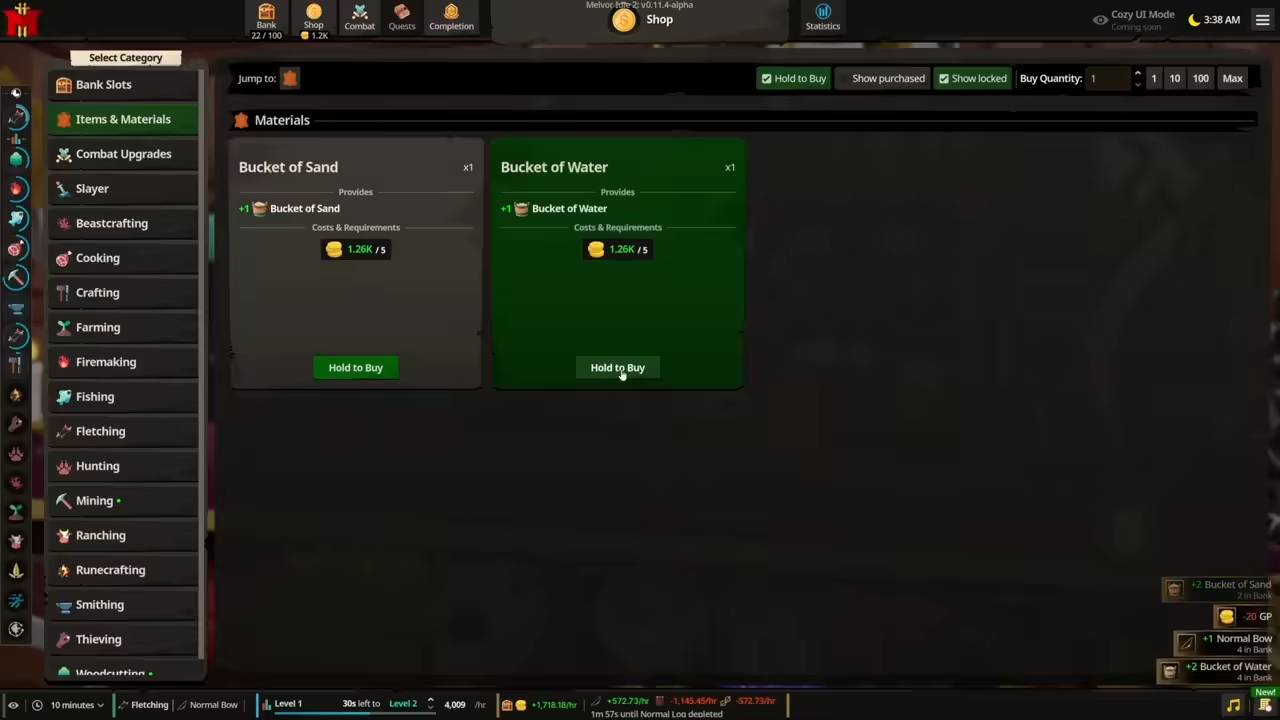
Right now I have 92 spaces out of 200. You can go into the shop and go into bank slots and you have certain requirements and certain gold to add 25 bank slots for you. If I do have the money for it, I usually will just buy it straight away because I want to make sure that when I make the game go idle, I'm not going to run out of bank space.
Kind of like what I said, buying bank slots is very important and there's many other upgrades that are going to boost your efficiency in skills, unlock certain skill requirements, and give you special abilities across all skills. Rather than spending your money simply because you can afford something in the shop, think about whether that purchase will make your next few hours of progression easier or more productive. If there's a skill that you know you're about to work on and you have the money for its upgrade, I recommend you buying that upgrade before you start activating and leveling that skill.
These upgrades can give you a plethora of different bonuses, like 2% increase to output doubling chance in crafting. You can hire farm hands in farming. You can have a 5% increase of special item chances for drops in fishing, plus 3% step skipping chance in fletching.
So I recommend when you do have some cash, check out the shop and be sure you're buying the upgrades associated with the skills that you're currently working on and leveling. Now one of the more interesting aspects of this game, and I really like that they have this because it adds another layer of progression and something to work towards, is the mastery guild system. In Mervor Idle 2, that system has been completely reworked into mastery guilds.
These guilds use tasks within a skill to unlock additional bonuses as you progress through them. That means there's more to consider than simply increasing your skill level, making the best piece of gear that you can, and crafting the highest level item. You'll want to check what the guild is asking you to do and whether completing those tasks can provide useful bonuses.
Anything that helps improve the efficiency of your activities can potentially save a considerable amount of time throughout your progression. For instance, we're going to go to mining, and as you can see, I'm already level 57 mining and I've unlocked a ton of different ore types. If I go to mastery, I can see that I have easy and novice unlocked.
If you look over here, in order to get your first upgrade, which is going to give me plus 10% to mining XP, I need to finish 21 tasks until I get apprentice miner. Break 250 stone. That's the first type of ore that you can mine in the game.
I only mined it 151 times and then I stopped mining it because I don't need it anymore. But if I were to just keep mining it along with clay, copper, silver, and I get 21 of these completed, I will automatically give me a massive boost to mining. But be sure you're keeping a lookout on all the mastery requirements because focusing on this is not only going to give you resources that you could potentially craft with, but it also give you an ability to level that skill and you're going to be working towards this mastery level which then can give you massive bonuses that will assist you a lot over time.
I'm level 45. If I go to my mastery and I go to my novice tab, I haven't even finished the first quest which is stone gear melee weapons and stone gear armor, which is the first set of armor that you get in the game. So right here, I need to start working on a lot of mastery to give me those bonuses.
It's returning in Melvor Idle two, and although it's been changed considerably from the original, the developers have confirmed that it remains a relatively safe skill that provides bonuses affecting many other areas of the game. The key is understanding what you're actually gaining rather than automatically training a skill simply because you're going for an item that you're trying to get. Combat is an area where preparation becomes especially important because your character can take damage and potentially die if you're not paying attention.
Look at your character's health, damage, defensive capabilities, and how your food and healing work. You're going to see all your equipment that you can equip. So, as you can see, this one requires me to have a attack level 12 in order to equip the copper mallet.
Iron requires me to have a attack level 20 and so on and so forth. And as you can see, I'm going to kill this guy instantly, so we're not going to use this guy as an example. As you can see, this is the enemy's evasion ratings.
This lets you know what kind of combat style you're going to want to be using against that enemy, especially if you want to set your character up to go idle to be ensure you're dishing out the most damage.
Melvor Idle 2: A RuneScape Adventure: How to Change Spells
The Spell Changing Problem
I have 9k water runes, and 3k chaos runes yet cannot use the second tier water spell. It was the same with the first tier spells. I could only use air spells no matter how many runes I had.
Clicking on a spell does nothing, trying to turn the air version off and then turning say water or fire on does nothing. Can you just not change spells?
Steam player, original post
How to Change Spells
Its based on the element of your currently equipped magic weapon. It will only give access to the associated elemental spells .
Steam player
So now you have: Rainbow staff for fire Toxic Powder wand for air Phantasm wand for water etc.
Steam player
More Melvor Idle 2: A RuneScape Adventure Guides
Did this work for you?
Related topics: crash fixes, save fixes, quest fixes