 Day One Fixes
SolvedHow-toUpdated
Europa Universalis V: A General Guide to EU5 [1.3 Pavia]
Short answer
A lengthy run-through of the important aspects of EU5, going through the game's menus and tabs.
Steam Community guide by iudiciis.
Introduction
Are you intimidated by Europa Universalis V's smorgasbord of UI menus, options, and things to do? Are you not afraid to read too many words anyway? Then this guide is for you! I'll hopefully have your back as you navigate your country towards or away from history's top ten mistakes of all time.
I am not going to tell you what to do during a playthrough. Other guides do that better. This guide is meant to explore the various UI menus of the game and explain what we're looking at and aiming to do in each of them. You'll notice very quickly which aspects of the game I consider important and which are more situational based on the amount of text I dedicate to them in this guide.
Note that this guide is not intended to replace the in-game learning walkthrough, and is not meant to get too deep into the workings of the game. If you haven't already, before or during your time reading this guide, you should ideally select one of the recommended starting countries and run through the Learning Walkthrough, Economy Walkthrough, Politics Walkthrough, and Expansion Walkthrough.
It'll at least give you a good idea of what each of the primary UI menus are for even if all the words go in one ear and out the other.
Before We Start
A lot of the time, I'll be directing you to the game's tootlips or hints system rather than describing things in my guide. This is for a few reasons: most importantly, it means I get to type less. Less importantly, they usually describe things well enough for you not to need this guide... and they also have more nested tooltips that describe even more things!
You can access hints by hovering over the thing you want a hint on and then clicking the hint button on the tooltip, or by directly accessing the hints panel from the right-side menu. And if you've forgotten how to access a tooltip, they're the infoboxes that pop up when you hover over things with your cursor.
On the topic of tooltips, you'll also want to be hovering over things a lot of the time to read up on what everything does. Being able to quickly get a run-down on what you're looking at via a tooltip is often much faster and easier than having a guide[forum.paradoxplaza.com] or the wiki[eu5.paradoxwikis.com] on a second monitor. Plus there's a lot of intricate details that will inform much of your decision making, and you'll want to be a wise and informed ruler before you inevitably do something stupid.
And make sure you have fun reading, because you'll be doing a lot of that. It's a Paradox Interactive game, after all!
Disclaimer
Depending on when you read this and when this was last updated, parts of this guide may be outdated (especially with all the changes that keep coming out from recent patches). Make sure you cross-reference anything you're suspicious of with sources like the hints system and the Europedia, or from Paradox's official forums. Post a comment down below if you see anything that needs changing!
Government
This is where you'll be figuring out how your country works. The reforms, privileges, and laws you decide on will form the core, yet interchangeable number-go-up stat buffs your country relies upon.
Country
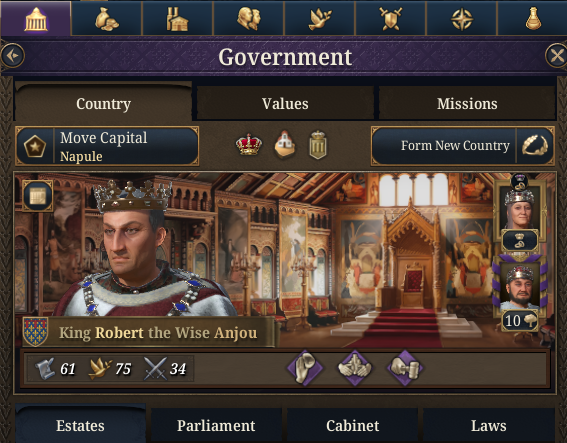
The country window details the various workings of your government. Though we won't go into them in much detail, you'll want to take note of a few things. The interesting things to look at here is the Move Capital button, Form New Country button, the consort and heir portraits to the right of our fine ruler, our ruler's stats, and our three ruler traits. Details to keep track of later on in a run might include your Country Modifiers, and your country's Complacency.
Under the heir portrait is a very small button that allows you to change your Succession Law. You can unlock more with future Advances. Hovering over it allows you to view the line of succession and plan which unworthy heirs to rid yourself of.
The Form New Country option allows us to rank up our country, reform our form of government, or to form a new country entirely. For example, Naples can form The Two Sicilies. Note that a Game Rule decides what countries are formable, if any.
Ruler traits are only active for a character when they are a Ruler. If your Ruler dies and is replaced by an heir, the heir-turned-Ruler slowly but randomly gains new character traits over several decades. It is possible to also gain traits from events.
You can learn why you would be interested in any of these things by hovering over them and reading the tooltips.
Other fun facts about your Ruler can be explored by opening your Ruler's Character Panel, which is done by clicking on your Ruler. This panel will be explored in more detail in the Society -> People -> Characters section of this guide.
Country - Estates
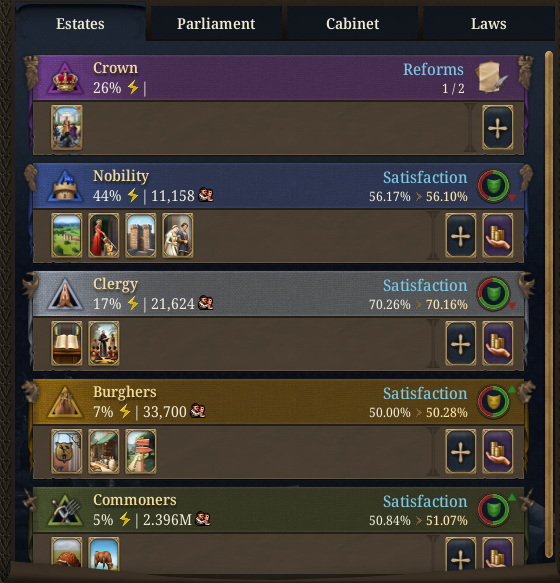
Estate Power
The main goal we have whenever we're on this screen mainly revolves around maximising our crown power, minimising the power of our more powerful estates, and extracting benefits from the less powerful estates. You can see a long list of reasons why we want high crown power if you read the tooltip, along with how estate power is calculated from political power.
We can quickly curb the power of our estates by revoking their privileges, but unfortunately this typically comes at a steep cost to our Stability and can easily drop estate satisfaction enough to invoke a dangerous civil war. You may want to drop the costs to a more reasonable level by raising your own Crown Power (the name of your ruling dynasty's Estate Power) and decreasing their Estate Power.
Unfortunately, doing so often requires buildings and advances that you will have to wait a while for.
Privileges and Reforms
You'll notice that we can give ourselves some nice privileges. Except they're not privileges - they're reforms! And you'll want as many of those as you can get. The in-game hint has a bit of detail on how you should go about enacting them and where to get more of them, so feel free to read that also.
If reforms make our country better, then privileges make our country worse, right? Wrong! Estate privileges may make the estates stronger, but they typically give you a few bonuses and a small estate satisfaction equilibrium increase. Some of these bonuses can be particularly powerful in the early game: for example, the Commoners can get the Common Militias privilege that increases their levies by a whopping 25% 15% (now in 1.3!) 20%.
Also note that privileges and reforms do not immediately come into full effect. Depending on your Legislative Efficiency, how quickly a given privilege comes into 100% effect will take some amount of time.
Estate Satisfaction
Don't ignore the equilibrium increases from Estate Privileges either. The nice thing about high equilibrium is that you can annoy them more before they get uppity and start rebelling. If you automate your tax levels to keep their happiness at 50%, a higher Satisfaction Equilibrium will naturally equate to more coins in your treasury. But do note that it will be harder to make Estates happy the more powerful they are. (You can check all the factors by hovering over the Satisfaction Equilibrium stat.)
Even nicer is that your estates also benefit you when they're happy. Even if you don't care for them, you should know that the most important benefit comes from the Clergy. If you read the tooltip, you will notice a significant boost to monthly research progress!
Note that if you are a Catholic nation, you don't have to think about lowering their taxes to make them happier. Their maximum tax starts at zero.
Estate Actions
Along with the set of privileges you can hand out, you can also ask things of your Estates. They are pretty self-explanatory, and allow you to make good use of banked or excess Estate Satisfaction, either as part of a devious plan or in response to an emergency that requires your Estates to help bail you out of.
Interesting actions to note include:
- Request Noble Envoys - Instant boost of Diplomats for some Satisfaction, great for quickly tackling Antagonism after a fruitful war, or to send out a flurry of diplomatic messages at the drop of a hat.
- Request Clerical Endorsement - Instant boost to Legitimacy for some Satisfaction, useful in cases where you need it boosted quickly to escape a rebellion or a dangerous event.
- Ask for Extra Levies - Increased size of levies. Use before raising an army to gain the advantage in attack or defence, with different use cases depending on which Estate you use this with. Losing a greater percentage of your population will certainly hurt, but if they were Nobles, then surely that will weaken them...
- Appeal to the Commoners - 20 Stability for 20% satisfaction.
- Call Emergency Parliament - Great for getting some Parliament Requests in a pinch in exchange for Legitimacy. More details in the Parliament section of this guide.
If you ever find your estates unhappy with you, and you would like them to not be unhappy with you, they do accept bribes.
Hints
Bribe too expensive? Giving them privileges can at the very least tide your Estates over long enough to snuff out any sparks of revolution if tax cuts aren't making them happy fast enough.
There also exists a Cabinet Action that, when below 50% happiness, will allow you to more quickly increase an Estate's satisfaction to its equilibrium point, or as a stopgap solution when they are unhappy (or to tax them more).
If you feel like all this back and forth between keeping your Estates happy and your personal throne powerful is too much politics for your soul, you can always leave it to the game to automate.
Country - Parliament
Every few years or so, you'll find yourself with an Alert that tells you that it's time to call Parliament. What kind of parliament is called can be changed at a hefty cost to Legitimacy, though it'll be necessary if you ever start with No Parliament or research a better parliamentary system.
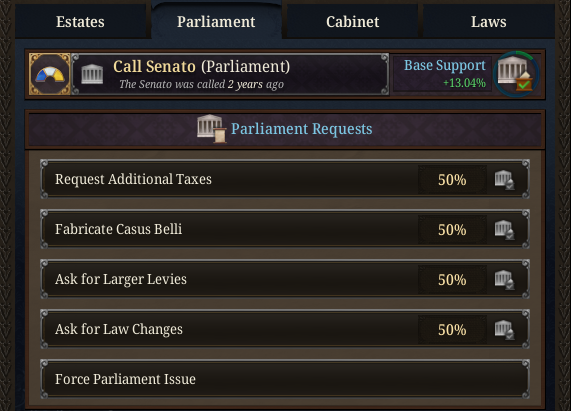
By calling parliament, you get a selection of options offered by your various estates. Depending on what you want, you'll either go with a Parliament Issue you particularly want, or you pick the Issue with the most support for one of the Parliament Requests.
The support your issue starts with comes from your Base Support + the estate power of the proposer (often none if you pick a crown issue). If you have enough Parliament Support (at the start of the game, a default minimum of 50% support) by the end of parliament, the Issue goes through, and if you have less than that, you will be penalised based on the issue your Parliament debated. Usually, this will involve a loss of 7 stability.
During a session of parliament, random events can nudge your Parliament Support up or down. You can also bump it up yourself by accepting one of your estate's Parliament Agendas, which require you to tradeoff something they want for their support. Some things they want are quite permanent, yet they can sometimes also align with what you want. Getting rid of a few Toll Castles might make the Nobles angry, but it'll also decrease their power!
Parliament Requests are important. They allow you to either raise the maximum taxes on your estates, get parliament approved CBs (Casus Bellis) for declaring war with, increase your levies, or change one of your Laws. Although they eat up a base cost of 50% of your Parliament Support, these Parliament Requests typically let you get CBs or Law changes for far cheaper than if you tried without asking parliament. Plus, requests don't need the issue to pass, because you receive their benefits immediately.
Note that where parliament occurs affects Centralisation/Decentralisation, and also has the unfortunate side effect of automatically failing when another country militarily occupies parliament in the middle of a session.
Also note that some International Organisations also have a Parliament.
If watching your Estates argue back and forth in a kangaroo court is not to your tastes, you can always leave Parliament automated, and come back to it when you are ready.
Country - Cabinet
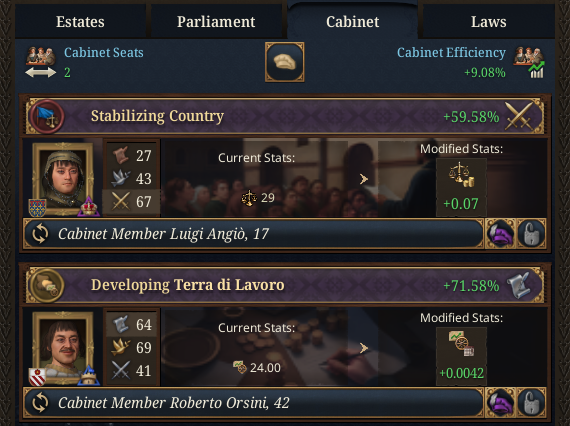
The Cabinet window is where your country does all the legwork. As the Possible Cabinet Actions hint helpfully mentions, you should always have all Cabinet Seats used at all times.
At the top, you can see your total Cabinet Seats, the current Cabinet Efficiency, and hire new Cabinet Members if you are desperate for a new one. Unless your courtiers suddenly all agree to become celibate, you will generally not lack for new Cabinet Members for a while.
You will most likely become familiar with Cabinet Actions after conquering a few provinces. For example, in order to start taxing your conquests properly and to avoid rebels rising up, you will need to assign the Integrate Province action to start integrating your new lands into your nation.
The other actions are also quite powerful, and you should take note of each one so that you are aware of the tools at your disposal. And, of course, read up on each action's tooltips to figure out what they do, exactly.
Cabinet Members, on the other hand, boost the effectiveness of their respective Cabinet Action. A strong diplomat, for example, would be well suited to assimilating pops into your culture. Be aware that characters appointed to the Cabinet will increase the Estate Power of their Estate, notably Crown Power if they are a member of the Crown. Don't just shove all your family members into the cabinet, however, because nepotism does not make for a very efficient nation.
You can promote one of your Cabinet Members to permanently become the Head of the Cabinet until their death. For a small cost of ducats and legitimacy, your Head Cabinet Member will gain various bonuses including to their personal Cabinet Efficiency. This action can also serve as a way of further boosting an Estate's Estate Power for some Satisfaction Equilibrium, or to boost your Crown Power and gain some monthly benefits.
Note that even if female characters aren't eligible for the role of Cabinet Member, you can decide to Grant Cabinet Rights to female characters for a chunk of legitimacy. This can be useful if every other candidate for cabinet is a lousy good-for-nothing or your daughter turns out to be a bona-fide genius.
You will unlock more interesting and powerful Cabinet Actions through research as the game progresses. Becoming a Hegemon will also unlock their respective special Cabinet Actions (if any) if you manage to become that strong.
Try to be comfortable with swapping out Cabinet Actions at a moment's notice, because you won't want to waste your Cabinet Actions if you can help it. Unfortunately, replacing Cabinet Members at a moment's notice is not as easy, but you should consider taking the minor stability hit if you feel it would be worth it.
Of course, if you don't want to bother with this cabinet nonsense, you can leave it to the game to automate.
Country - Laws
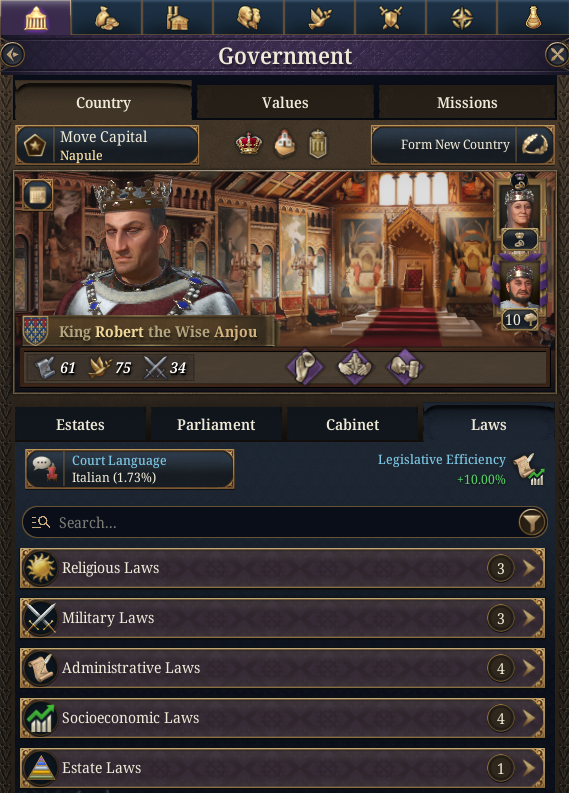
Here, you can take a look at your Court Language, Legislative Efficiency, and of course all the various laws your country has implemented.
Changing your Court Language costs some Stability. Dialects with higher Language Power confer certain benefits. In this case, a Court Language with high Language Power increases the Estate Satisfaction of the Nobility. There are also other benefits to which language you decide upon (such as increased Commoner satisfaction with a Common Language) that you can discover by reading their respective tooltips.
Because they explain it well enough, here's a tooltip about how Laws work.
Note that policies do not immediately come into effect. Depending on your Legislative Efficiency, how quickly a given law comes into effect will take some amount of time.
You will also notice changing policies can be very expensive for your stability. Consider using a Parliament Request instead.
Of course, if you feel like this legal jargon is giving you a headache, you can always leave it to the game to automate in your stead.
Values
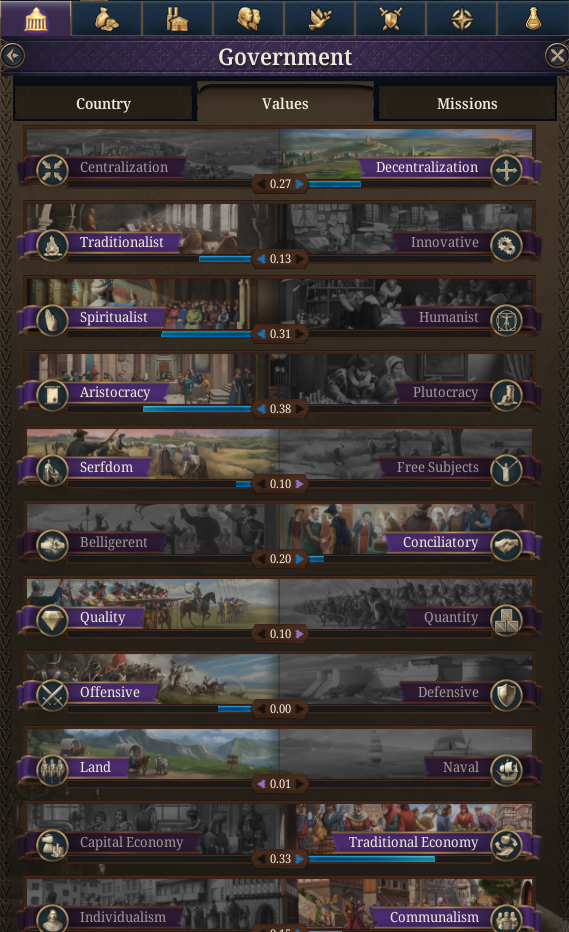
Societal Values are a more subtle game mechanic baked into practically all aspects of the game. Most of what you do will affect these Societal Values in one way or another, and you'll have to pay attention to your choices to ensure your country has the values you want for their juicy benefits.
I won't list all the things that affect your Societal Values because there's a lot, but just so you get an idea of just how wide-reaching this mechanic is, here's a few less obvious things that affect your Societal Values.
- How much you are paying in Army/Fort/Navy Maintenance
- How much Army/Navy Tradition you have
- How big your Army/Navy is
- Your religion's Laws
- Your Employment System
- Estate Power
- Whether or not you are at War
- Your ruler traits
- Your percentage of Nobles/Burghers/Soldiers/etc. pops
- How much Art you have
That's not to say they're all equally important or that you have to take all of them into account. Many affect only one Societal Value, and you likely won't have the brainpower to juggle advancing multiple values at a time if you try to micromanage all of these. Just focus on a few at a time, or when you find yourself with a choice that tells you it will affect one of your values.
Some Ages will unlock a new Societal Value to keep track of. Previous Laws and such that you have implemented previously often will secretly affect these values, and might not tell you they do so until the value is unlocked. You can see a list of Societal Values by hovering over the Societal Values tooltip.
What values you want is entirely up to you, though you should be aware that your priorities likely will change between early-game and late-game.
You should also note that:
Missions
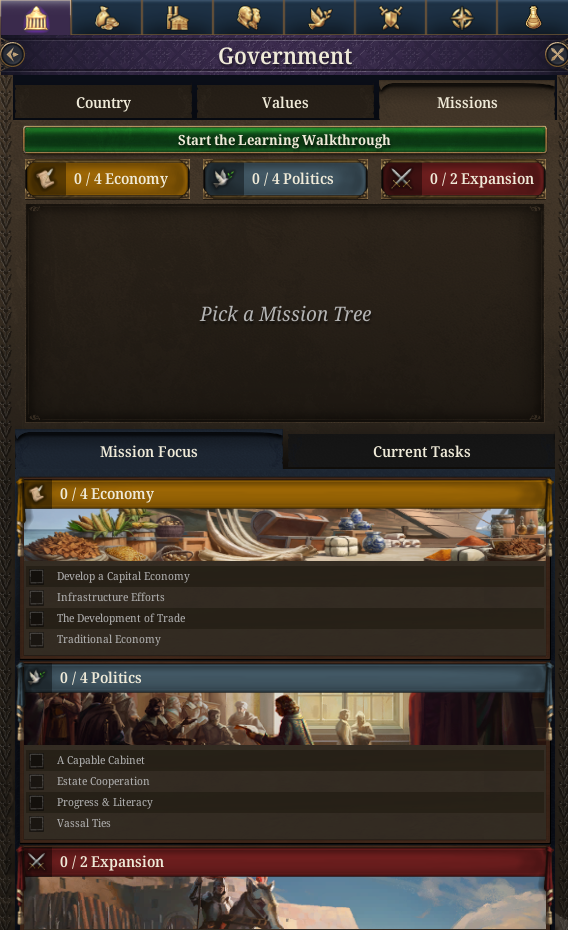
Missions are the game's way of introducing you to various aspects of the game in a more hands-on manner by having you put theory into practice.
Missions only appear when enabled in the Game Rules. You'll likely see or have already seen Missions when you started your first tutorial playthrough.
Depending on the Game Rules, Missions may also give you benefits when you complete the entire Mission, parts of each Mission, or simply not at all.
You can also go through the Walkthroughs again from this panel if you wish to do so.
Events
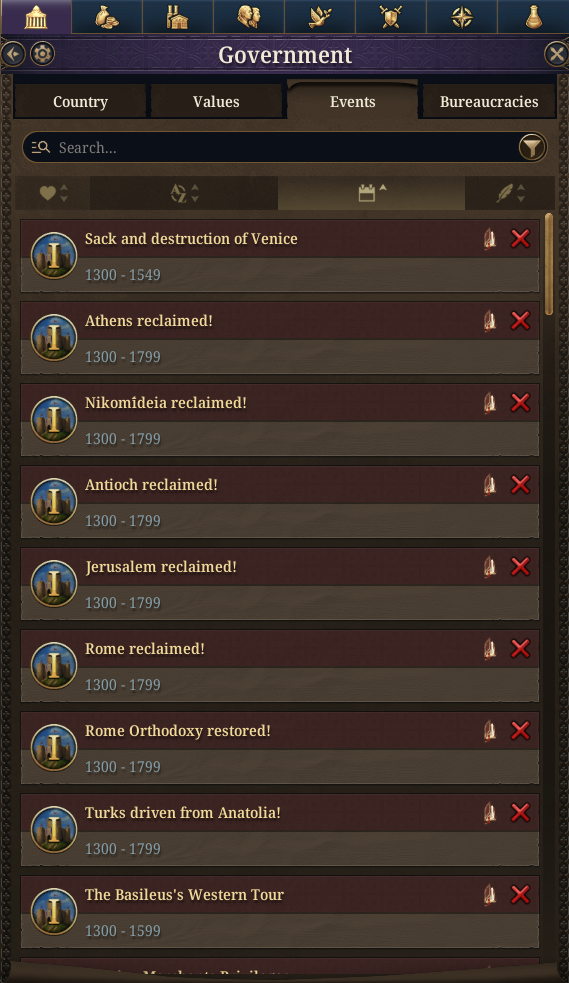
Take a moment to look at all the historical events available for you to experience. Though, as is the nature of a video game, you will probably not experience all the events in a run. But with the power of hindsight on your side, you'll at least have the ability to check out some interesting events and try working towards them if you find any with interesting benefits for your nation.
Note that the optimal starting strategy for some nations will often need you to be aware of your country's related events (e.g. Milan really wants to take Pavia), as the events ofte